Is AI Music Allowed on Spotify in 2026?
Learn about Spotify's 2026 AI music policy, rules for uploading AI-generated songs, and tools like Soundverse ensuring ethics and compliance.
Is AI Music Allowed on Spotify in 2026?
Introduction
As we move deeper into 2026, one of the most frequently asked questions among musicians and producers is: Is AI music allowed on Spotify in 2026? Artificial intelligence continues to reshape how music is created, distributed, and monetized. From AI voice synthesis to generative beat creation, creators are experimenting with machine-made compositions. But questions about legality, attribution, and platform regulations still puzzle many. With growing scrutiny from record labels and rights organizations, knowing what’s permissible on streaming platforms such as Spotify is crucial for anyone generating AI-based music.
This article explores Spotify’s AI policy, AI-generated songs streaming rules, and the evolving music distribution regulations surrounding synthetic audio in 2026. We’ll also explain how creators can safely release and monetize their AI tracks using ethical frameworks like Soundverse’s Ethical AI Music Framework.
What Is Spotify’s AI Music Policy in 2026?
Spotify entered the AI conversation years ago, but 2026 has seen more refined regulations. In 2024 and 2025, the company faced controversies over AI voice clones and synthetic songs that mimicked popular artists. Since then, Spotify's approach has shifted toward a policy emphasizing transparency, consent, and attribution. As of 2026, Spotify allows AI-generated music only if the creator can verify that their content complies with intellectual property and ethical sourcing standards.
Spotify now categorizes uploads into three main types: human-created, AI-assisted, and fully AI-generated. Each category has documentation requirements. For the AI-generated type, creators must disclose whether training data included copyrighted audio, and confirm that all rights-holders provided consent. Songs created with unethical data scraping practices are not accepted.

What Are the Streaming Rules for AI-Generated Songs?
From the artist’s upload process to distribution agreements, Spotify’s AI-generated songs streaming rules follow three principles:
- Transparency: Uploaders must disclose whether AI tools were used during composition or production. This ensures listeners and rights-holders understand the origin of the music.
- Attribution: Spotify now requires metadata specifying which AI model or platform generated the track. For example, a creator might list “Produced with Soundverse DNA” to clarify authorship.
- Rights Validation: Spotify performs deep checks to verify that no copyrighted materials were used without permission. Uploads originating from unauthorized datasets are systematically rejected.
These policies stem from global pressure on streaming platforms to respect artist rights while supporting innovation. Many creators have already shifted toward ethically licensed AI systems because clean data speeds up approval and monetization.

What Is the Process of Uploading AI Tracks to Spotify?
Uploading AI-created songs in 2026 is similar to traditional releases—through distributors such as DistroKid, CD Baby, or TuneCore—but with additional verification layers. Here’s what creators generally need:
- Proof of Licensing: You must prove that your AI model was trained using licensed or consented datasets. For instance, creators using tools like Soundverse DNA automatically receive proof of dataset licensing.
- Metadata Labeling: When filling in track details, you add tags like “AI-generated instrumental” or “AI-assisted mix.” This classification prevents confusion between human and machine authorship.
- AI Artist Guidelines Compliance: Spotify’s 2026 update requires AI artists to register their pseudonym and model identity. This guideline helps track royalties and recurring usage statistics.
For creators distributing AI tracks, compliance ensures smooth publication and preserves earning potential. Without disclosure or licensing proof, tracks risk takedown.
Why Have Music Distribution Regulations Tightened in 2026?
Global authorities and music rights organizations have tightened rules for AI-generated works due to the surge of synthetic music flooding platforms in 2025. Artists protested data scraping practices where AI systems trained on copyrighted material without permission. In response, platforms like Spotify and Apple Music updated distribution regulations.
In 2026, music distribution regulations focus on three major areas:
- Ethical data sourcing. Creators must use authorized datasets to avoid infringement.
- Attribution auditing. Platforms check metadata and watermark signals to ensure verifiable origin.
- Recurring compensation. Rights-holders receive royalties even when their sound signatures contribute indirectly to AI generations.
These measures promote a fairer ecosystem where AI creativity coexists with artist integrity.
How Are Musicians and Producers Adapting to AI Artist Guidelines?
Musicians now approach AI as a co-creator rather than a competitor. AI artist guidelines introduced in late 2025 require that synthetic artists follow similar onboarding processes to human creators. Producers have started integrating AI tools into creative workflows for genres like electronic, ambient, and film scoring.
Many professional creators use AI responsibly by employing platforms with transparent licensing and attribution systems. By 2026, Soundverse, Amper, and Mubert have become standard tools for AI-assisted music generation. You can explore comparisons and alternatives in articles like Mubert Alternatives – Soundverse and Soundraw Alternative, which explain how ethical frameworks maintain compliance.
To expand your workflow further, watch our Soundverse Tutorial Series - 9. How to Make Music or explore our Deep House Music tutorial for practical inspiration.
Is AI Music Legally Protected in 2026?
Copyright law remains complex for AI-generated music. Most jurisdictions recognize copyright only when a human demonstrates creative control. However, legal reforms in the EU and US started acknowledging hybrid works—music co-written or co-produced by AI under the supervision of a registered artist. This legal shift encourages creators to include traceable authorship markers and model identities.
By linking human oversight to AI output, creators retain rights. Platforms like Soundverse embed traceable signatures in exported audio files, allowing platforms like Spotify to validate the human-AI partnership.
How to Make AI Music on Spotify in 2026 with Soundverse The Ethical AI Music Framework
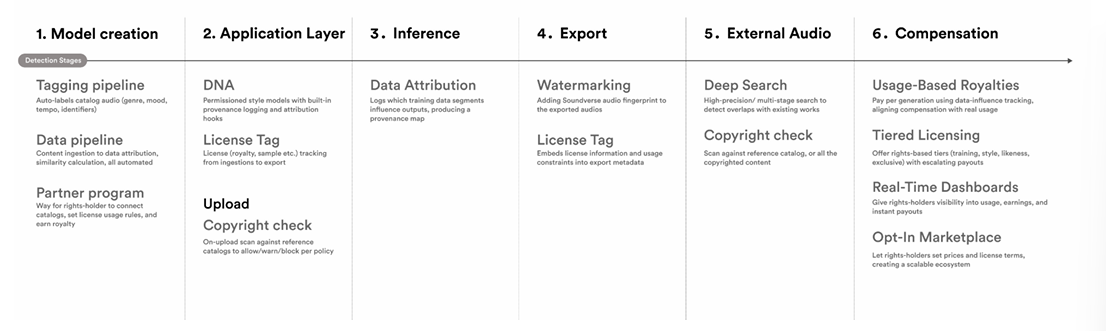
Now that we’ve reviewed Spotify’s AI music regulations, let’s discuss how creators and distributors can comply efficiently using Soundverse’s Ethical AI Music Framework, an industry-leading platform designed for ethical AI music production.
Soundverse’s framework delivers an end-to-end infrastructure connecting innovation and artist integrity. It replaces black-box models with a transparent six-stage pipeline guaranteeing consent, attribution, and recurring compensation. Here’s how it aligns with Spotify’s AI policies:
- Stage 1 – Licensed Data Sourcing: All training data is fully licensed. This stage eliminates the risk of unauthorized scraping, ensuring legality when your track reaches Spotify.
- Stage 2 – Permissioned Models (DNA): The “DNA” system lets artists license their unique sound signature for AI generation. This supports fair use and recurring royalties.
- Stage 3 – Explainable Inference (Attribution): Every generated piece carries an identifiable attribution pathway, simplifying rights auditing.
- Stage 4 – Traceable Export (Watermarking): The framework embeds traceable watermarks, making AI-generated content verifiable when distributed.
- Stage 5 – Deep Search (External Scanning): Soundverse conducts external scans across platforms, detecting any potential overlap with unlicensed content.
- Stage 6 – Recurring Compensation: Rights-holders gain recurring, usage-based royalties through the Content Partner Program.
Together, these stages equip creators to safely release AI-generated music on Spotify while maintaining compliance with streaming rules and music distribution regulations. The Ethical AI Music Framework is particularly valuable for enterprise users and independent artists seeking transparency and long-term monetization.
For musicians ready to experiment with genre-based generation, you can read our guides: How to Create Country Music with Soundverse AI, Generate AI Music with Soundverse Text-to-Music, and How AI-Generated Music Is Transforming the Music Industry. These resources show practical ways to create original, copyright-safe content compatible with Spotify’s updated AI guidelines.
Start Creating AI Music That’s Spotify-Ready!
Unlock the power of AI music creation with Soundverse—generate, refine, and publish professional-grade tracks that comply with modern streaming standards. Stay ahead of the 2026 music revolution.
Create Music with Soundverse
Related Articles
- How AI-Generated Music Is Transforming the Music Industry: Explore how artificial intelligence is reshaping music creation, distribution, and the future of streaming platforms.
- AI Music in the USA: Learn how AI music regulations and innovations are evolving in the United States and shaping creator opportunities.
- The Role of AI Music in Film and Television: Dive into how AI-generated compositions are redefining soundtracks in entertainment and boosting creative workflows.
- Navigating the World of Royalty-Free and Copyright-Free Music Using Soundverse AI: Understand how to safely use AI-generated music across platforms without licensing headaches.
Here's how to make AI Music with Soundverse
Video Guide
Here’s another long walkthrough of how to use Soundverse AI.
Text Guide
- To know more about AI Magic Tools, check here.
- To know more about Soundverse Assistant, check here.
- To know more about Arrangement Studio, check here.
Soundverse is an AI Assistant that allows content creators and music makers to create original content in a flash using Generative AI. With the help of Soundverse Assistant and AI Magic Tools, our users get an unfair advantage over other creators to create audio and music content quickly, easily and cheaply. Soundverse Assistant is your ultimate music companion. You simply speak to the assistant to get your stuff done. The more you speak to it, the more it starts understanding you and your goals. AI Magic Tools help convert your creative dreams into tangible music and audio. Use AI Magic Tools such as text to music, stem separation, or lyrics generation to realise your content dreams faster. Soundverse is here to take music production to the next level. We're not just a digital audio workstation (DAW) competing with Ableton or Logic, we're building a completely new paradigm of easy and conversational content creation.
TikTok: https://www.tiktok.com/@soundverse.ai
Twitter: https://twitter.com/soundverse_ai
Instagram: https://www.instagram.com/soundverse.ai
LinkedIn: https://www.linkedin.com/company/soundverseai
Youtube: https://www.youtube.com/@SoundverseAI
Facebook: https://www.facebook.com/profile.php?id=100095674445607
Join Soundverse for Free and make Viral AI Music
 We are constantly building more product experiences. Keep checking our Blog to stay updated about them!